

Data Governance Is Everywhere — And Still Misunderstood
Most large organizations now tick the visible boxes of data governance: a named program, a documented policy, designated data stewards and committees, and frameworks cited in slide decks. On paper, data governance has arrived. From the outside, many firms now resemble what the industry has been advocating for nearly twenty years.
But according to the people doing the work, beneath the formal structure lies a different reality.
What Practitioners Actually Experience
Survey responses from 348 data governance practitioners across 46 countries show that many practitioners operate in environments where data governance is still not well understood, accepted, or integrated into organizations’ systems. We refer to this as “the adoption paradox” — structure without shared understanding, presence without performance.
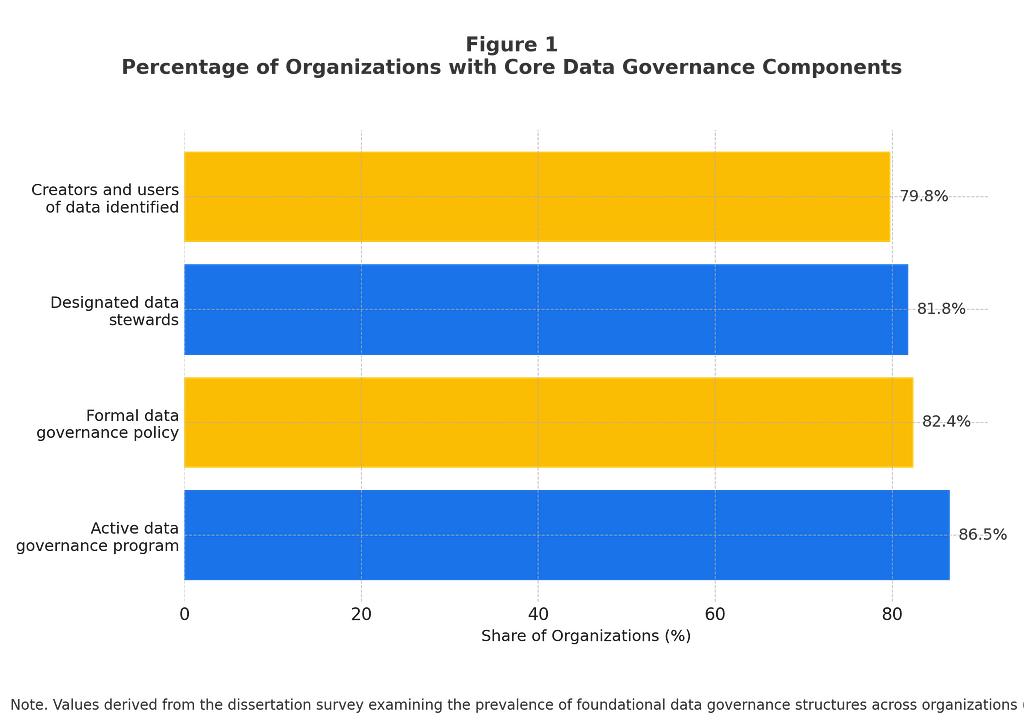
If we judged maturity solely by the presence of structures, it would look like success. However, the same practitioners who report strong structural coverage also say people within their organizations struggle to understand and work with those structures. A common theme emerges when interpreting practitioner endorsements of their most significant challenges: it’s a knowledge problem.
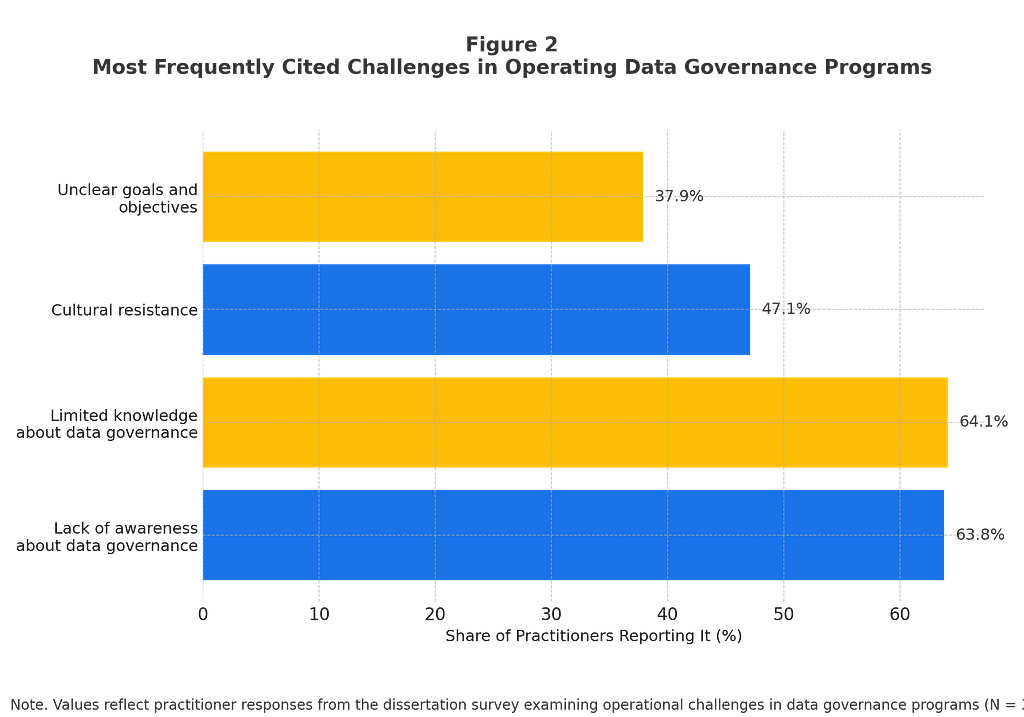
These are not edge cases. They describe the median experience: governance functions that exist but are not widely understood; expectations that have been drafted but not fully absorbed; and goals that are documented but not consistently shared. As data governance leaders, our job is first and foremost organizational change management, and our one job above all is to explain what’s coming next in a way people can actually understand. This, of course, would require a common understanding of data governance — that we don’t currently have.
But We Have Frameworks?!
Another key insight from the research concerns how organizations adopt data governance frameworks. I previously published an article based on the preliminary data. The survey asked: Which industry frameworks do you use (if any)?
Unsurprisingly, the DAMA Data Management Body of Knowledge (DMBoK) and the Enterprise Data Management Association’s (EDMA) Data Management Capability Assessment Model (DCAM) were the most prevalent.
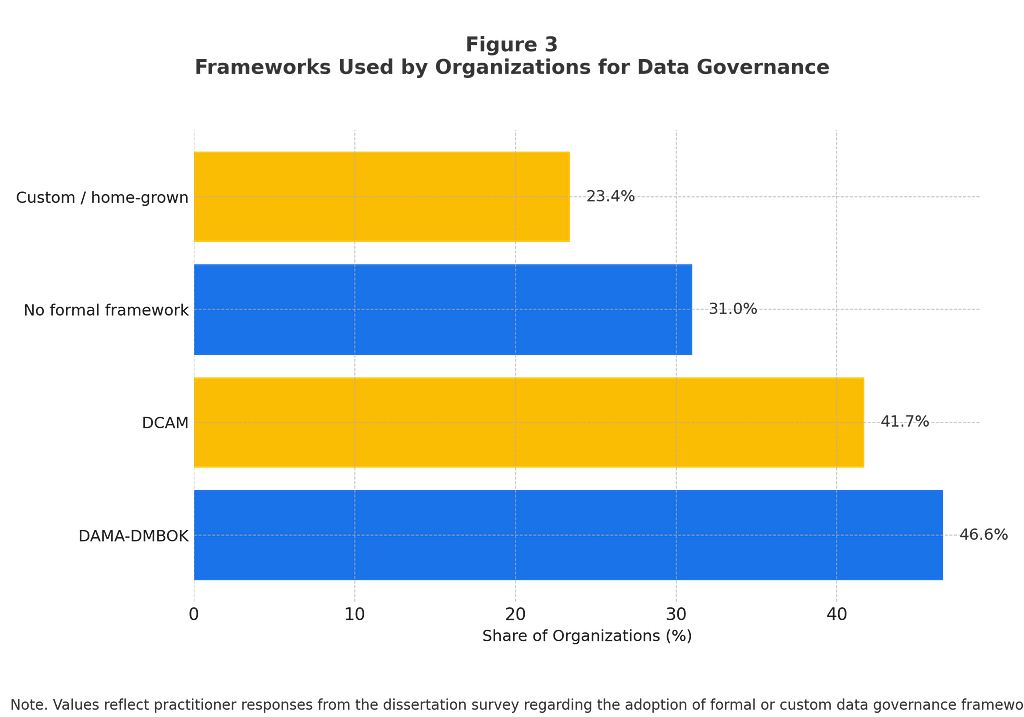
Some organisations used both DAMA-DMBOK and DCAM (≈ 19.2 %). Remarkably, 18.4% of surveyed organizations operate without a formal data management framework, and others indicated that their organizations rely on ad hoc or consultant-led models.
What this tells us:
Adoption of formal frameworks is far from universal.
Many rely on “mix and match” or bespoke models.
The diversity of approaches may reflect creativity — or it may reflect confusion.
When frameworks are loosely applied, partially adopted, or merely symbolic, they fail to provide the clarity and shared language needed for widespread understanding. That aligns directly with the high rates of “limited knowledge” and “lack of awareness.”
In essence, structure (policy + roles + framework) can exist while coherence (shared meaning + consistent application) does not.
Enforcement as a Stress Test
One way to determine if governance is more than just a box‑checking exercise is to examine enforcement. Do organizations actually respond when governance rules are violated?
The study found that organizations with a formal policy are much more likely to report consistent enforcement than those without one. When a policy exists and is visible, enforcement is the norm. When policy is absent or unclear, enforcement turns irregular and inconsistent.
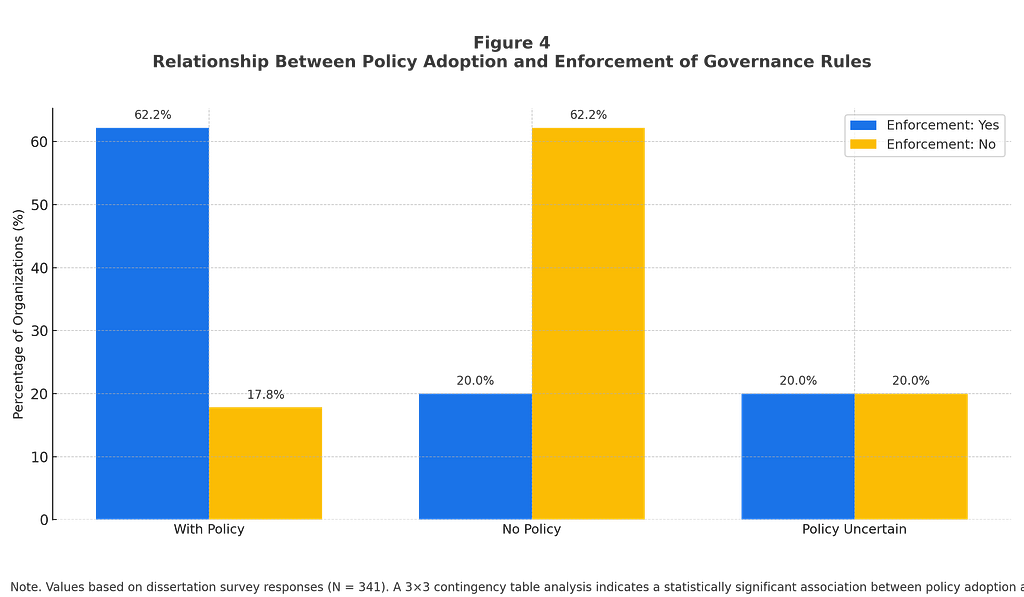
That pattern is important. It tells us that structure influences behavior, but only when people know it exists and understand how it applies to them. Policy alone doesn't ensure enforcement, but without policy, enforcement lacks a foundation.
Why Structure Is Not Enough
The literature on data governance has been debating definitions and frameworks for almost two decades. I cover this topic in depth in another article. However, the reality is that data governance emerged through necessity, regulation, and vendor pressure—before it had a stable conceptual foundation. Decades of reactive practice, limited empirical research, and competing perspectives created ambiguity at the heart of our field.
One consistent thread in academic and practitioner literature is that data governance is ultimately about decision rights and accountability — who decides what, based on which rules, and with what oversight. In theory, that sounds straightforward. In practice, those decision-making rights sit within silod, political organizations that face pressures from their macroenvironment. If governance is introduced mainly as a set of documents and committee charters, without equal investment in communication, relationships, and incentives, it tends to stall. People hear “governance” and think “extra work,” “slow approvals,” or “someone else’s job.”
The research points to a simple conclusion: structure is necessary, but not sufficient. Governance becomes effective when structure and behavior move together. Policies, roles, and frameworks provide shape. Understanding, engagement, and reinforcement supply energy.
The Human Side of the Problem
The challenge, then, is not to invent yet another governance framework, to refactor organizational structures, to adopt the most elegant architecture, or to buy the latest tools. It is to make the existing structures legible and usable to the people who are supposed to work within them. That means:
Explaining governance in business language, not only in technical or compliance terms.
Making roles and decision rights clear, so people know when governance applies and what is expected.
Aligning goals so that governance is seen as a way to achieve outcomes, not just avoid penalties.
Investing in communication and reinforcement, rather than assuming a policy announcement is enough.
These are not “soft” problems. They are the primary reasons that structurally sound governance programs fail to deliver on their promises. When awareness is low, knowledge is thin, and goals are unclear, it does not matter how many frameworks an organization has adopted. The system will drift.
What Leaders Should Do Next
If you are leading a data governance program or a data management function, it is worth assuming that your organization already has more governance structure than it has governance understanding. The question is not “Do we have a program?” The better questions are:
Do people across the business know what that program actually does?
Can they explain, in simple terms, how data governance affects their decisions?
Are enforcement actions predictable and fair, or ad hoc and painful?
Do our stated goals for data governance match how people experience it day to day?
Answering those questions honestly will likely reveal that the next wave of work is less about new structures and more about communication, clarity, and alignment. The data suggests that organizations that invest in those areas are the ones that move governance from paperwork to practice.
In other words, data governance is mainstream. The next step is to make sure people actually understand it.
Data Governance Is Everywhere — And Still Misunderstood was originally published in My Column Has NULLs on Medium, where people are continuing the conversation by highlighting and responding to this story.