

Designing Data Governance to Learn: What practitioner-reported goals reveal about value, coordination, and resilience
Being a data governance leader requires a certain tolerance for disruption and uncertainty. It’s the kind of role where even planning a family vacation feels risky. You never quite know when work will spike, because governance tends to surface precisely when something else has gone wrong.
In large organizations — and, honestly, probably most — you cycle through a familiar pattern. Sometimes, no one knows you exist. Sometimes people are quietly hoping you don’t show up. And then, usually without much warning, something breaks, a regulator asks a question, or a major initiative hits friction — and suddenly data governance is the most important thing in the room. Everyone wants time on your calendar. We’re the cool kids again.
Data governance can feel invisible, unwelcome, or briefly indispensable depending on what the organization is dealing with at the moment. That swing isn’t a sign that governance lacks purpose. It’s a reflection of what data governance actually is: a corporate governance capability intended to improve the data management function, operating across many roles, systems, and perspectives simultaneously.
Like all forms of corporate governance, data governance exists to set direction, establish accountability, and enable oversight. What makes it challenging is not its mandate, but the complex thing it governs. Data cuts across every function, every process, and every level of the organization, and is intangible and characteristically and behaviorally complex. As a result, the performance of data management — and the value it creates — is evaluated differently depending on where you sit.
We have concluded that this makes learning, not definition or control, the central design challenge for data governance.
The Many Goals of Data Governance
The findings in this article are from my dissertation research, Towards Resilient Data Governance, which draws on responses from 348 practitioners across 46 countries.
First, Participants were asked to identify their organization’s data governance goals, allowing multiple selections.
The results did not cluster around a single objective. They were broadly and consistently distributed. Most respondents selected multiple goals rather than one. On average, respondents endorsed more than five of the seven possible goals, and more than one-third selected all seven.
The most frequently endorsed goals included: Managing data quality (62%), Managing risk and compliance (57%), Supporting data strategy and transformation (52%), Building data culture and literacy (59%), and Defining and managing metadata (56%).
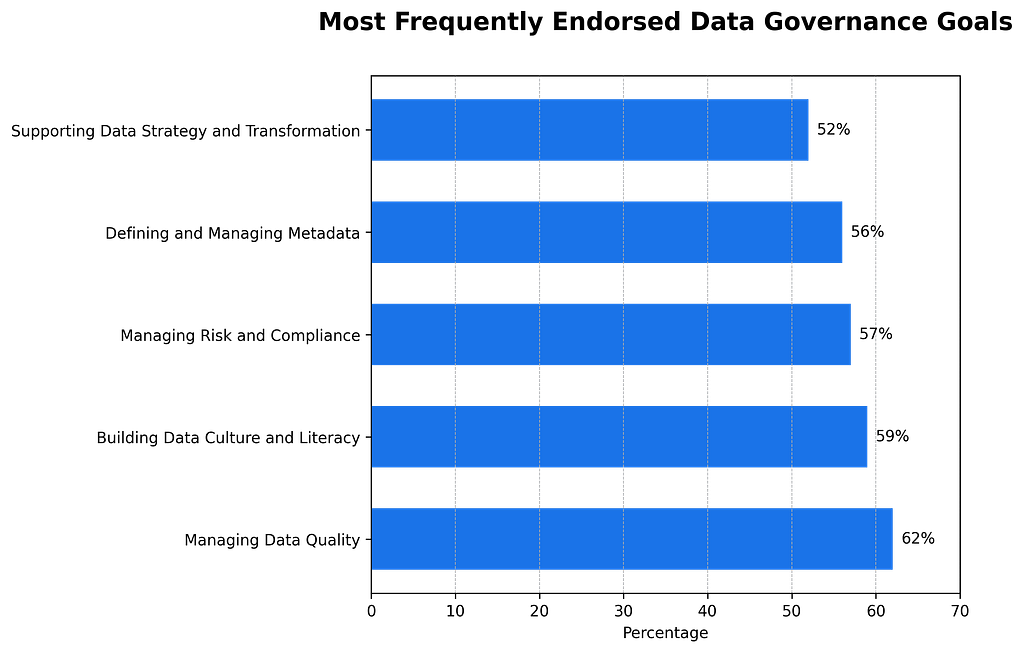
This reflects a practical reality that aligning and measuring data governance goals: improving the data management function requires progress across multiple dimensions at the same time:
Executives focus on decision quality, speed, and strategic return
Risk and compliance functions focus on control, defensibility, and exposure
Operations focuses on reliability and consistency
Analytics and AI teams focus on access, quality, and enablement
Business users focus on usability and trust
Each perspective is legitimate, but they are typically measured very differently — and although they generally want the same thing, that’s a tough story to tell. The challenge is not deciding which of these goals counts; rather, it is a coordination challenge — how the organization learns and acts across all of them.
The problem arises when these perspectives are evaluated in isolation. When learning remains local to each function, data governance becomes the place where tensions surface but are resolved only after impact occurs. That is why governance can feel alternately invisible or overwhelming: it is often engaged late, when consequences are already visible. Once the problem is addressed, that knowledge is usually retained locally.
This is not a failure of intent. It is a limitation of coordination.
Where Coordination Breaks Down
Some governance goals align naturally.
Data quality, risk management, and compliance all depend on consistent definitions, clear ownership, and reliable metadata. Strategic initiatives depend on quality because poor data undermines analytics, decision-making, and AI outcomes. Culture and literacy make governance expectations understandable to people doing the work.
Data quality illustrates this pretty well.
Data Quality teams monitor signals — rules, thresholds, exceptions, and trends.
Risk teams respond to incidents — loss events, findings, and escalations.
Leadership acts when consequences are visible — in dollars, regulators, or headlines.
When these learning cycles are not connected, organizations learn late. Signals exist, but action is triggered only after impact. Someone inevitably says, “How did we miss this?”
Well, the short answer is that we’ve created static and reactive data governance capabilities that lack mechanisms to translate early information into timely decisions.
Why does this matter? Late learning is expensive.
Motivations and the Influence of the Macro-environment
Respondents were also asked what factors had increased their organization’s focus on data governance over the past two years. The results validate that changes in the macroenvironment can (and have) materially increased the impetus for data governance in respondent organizations.
As with goals, no single motivation dominated. Instead, respondents pointed to multiple, concurrent drivers: the need to better manage data quality (62%), emerging risks, including privacy and security (54%), digital transformation initiatives (51%, AI transformation initiatives (50%), and New or evolving regulations (40%). Only about 5% of respondents reported no recent increased focus at all — business as usual for these guys, apparently.
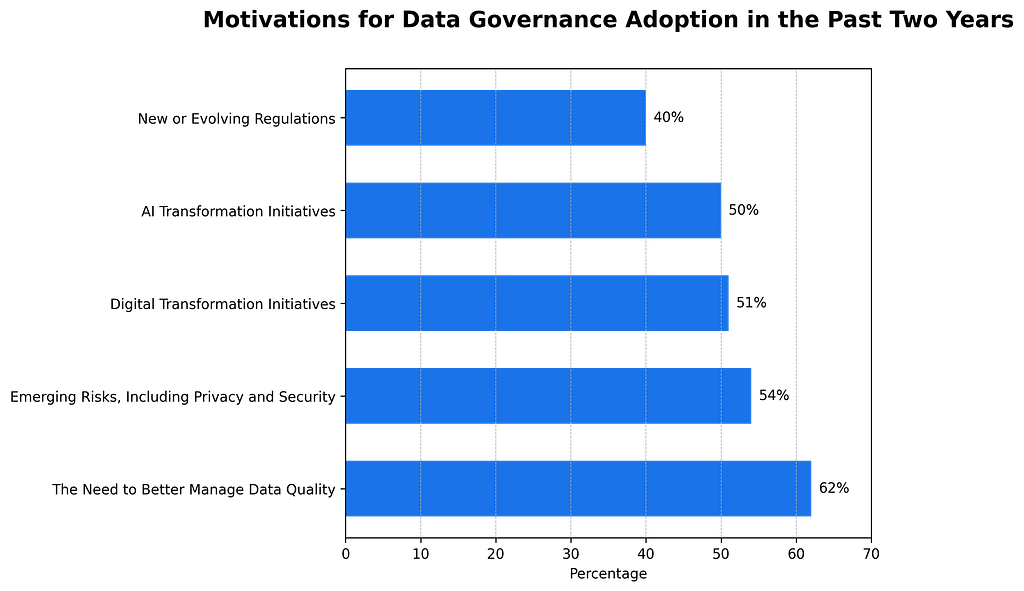
The significance of these results lies not in any individual driver, but in their simultaneity. Quality, risk, digital transformation, AI, and regulatory change all intensified at roughly the same time—and all depend on the same foundational capabilities: ownership, human- and machine-interpretable knowledge (metadata), controls, and feedback loops.
These endorsements indicate that data governance became more visible and more heavily relied upon because multiple parts of the organization simultaneously recognized the exact needs from different perspectives.
Without integrated learning and coordination mechanisms, data governance becomes the point where competing pressures surface, often late in the process, resulting in escalation, delay, or reactive (often localized) intervention rather than early adjustment or incremental scaling.
Considered circumstantially, it could be viewed as a temporary surge; the natural eb and flow of data governance sentiment. I used to think that it was that way; I no longer do. This is a structural signal that we have been ignoring. We now understand that Data governance operates under sustained macro-environmental pressure and must be designed accordingly.
A Simple Learning Loop for Data Governance
The coordination challenges described so far are often framed as execution problems. They are not. They are learning problems.
Organizations learn in different ways depending on the signals they recognize and the changes they permit. In organizational learning theory, this distinction is captured through single-loop and double-loop learning.
While most data governance operates in a single-loop mode — focusing on correcting immediate defects — true resilience depends on the depth of learning. Whether an organization simply fixes a data error or adapts the underlying governance intent depends on where that learning is allowed to occur.
Single-loop learning asks: Are we doing things right? It corrects execution without changing assumptions.
Double-loop learning asks: Are we doing the right things? It allows operational signals to modify governance intent, including policies, thresholds, and decision rights.
Most data governance activity operates in a single-loop mode.
Data governance operates through PDCA cycles, but whether organizations merely correct defects or adapt governance intent depends on where learning is allowed to occur.
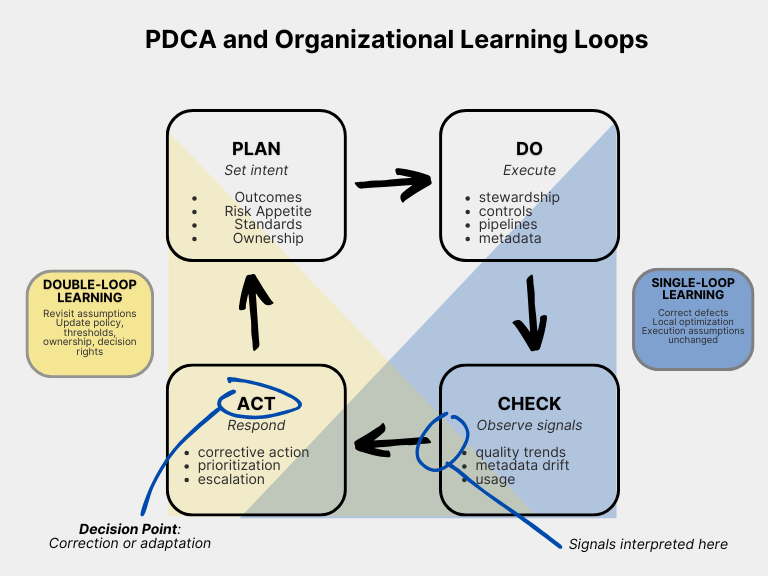
How to read this diagram
This diagram shows how data governance operates and how organizations learn from it.
Start with the square loop in the center. This is the familiar Plan–Do–Check–Act (PDCA) cycle. It represents the operating rhythm of data governance: intent is set, work is executed, results are observed, and responses are made. Most organizations already run this cycle, whether they label it or not.
The distinction appears at CHECK.
CHECK is where signals emerge — data quality trends, metadata drift, usage patterns, and exceptions. Detecting these signals is necessary, but it is not learning by itself. Learning depends on what happens next.
At ACT, the organization makes a choice.
If ACT focuses on fixing defects and restoring operations, the system follows the single-loop learning path. Execution improves, but underlying assumptions — policies, thresholds, ownership, decision rights — remain unchanged.
If ACT leads to revisiting those assumptions, the system enters double-loop learning. The governance intent is updated in the PLAN, and future execution changes accordingly.
Both paths are valid. The difference is depth.
Single-loop learning keeps the system running.
Double-loop learning makes it resilient.
The diagram highlights that governance adds value not by detecting issues, but by enabling signals to change decisions before incidents force escalation.
Data quality issues are detected and corrected. Controls are adjusted. Incidents are remediated. Reports are fixed. These actions matter, but they do not change the assumptions that shape how data is governed in the first place.
Double-loop learning occurs when signals from operations lead to changes in intent—when policies, thresholds, ownership, escalation paths, or decision rights are revisited in light of what the organization has learned.
When learning remains single-loop, signals lead to fixes, but not to changed expectations. As a result, the organization learns late. Governance becomes involved only after impact occurs, not when early indicators first appear.
This distinction explains why governance can feel busy but remain reactive.
Quality teams live in signals
Risk teams often live in incidents
Leadership lives in outcomes
Governance exists to connect them
When the loop works, governance feels anticipatory.
When it doesn’t, governance feels punitive or slow.
Why does it matter? Late learning increases cost, amplifies risk, and undermines confidence in governance, even when teams are doing competent work.
Data Governance Goals and Perception of Value
If learning is the constraint, value should appear where learning improves.
The dissertation compared practitioners who reported that data governance was worth the time and investment with those who did not.
Practitioners who perceived governance as valuable endorsed more goals overall — an average of 5.1, compared to 4.0 among those who did not.
More importantly, not all goals contributed equally to that perception.
After controlling for multiple comparisons, three goals showed a meaningful association with perceived value:
- Building data culture and literacy
- Supporting data strategy and transformation
- Defining and managing metadata
Other goals—data quality, risk management, and compliance — were present in both groups. They are foundational, but non-differentiating. They are necessary for operation, but insufficient to explain why governance is valuable. It’s important to note that the dataset size constrained the model performance, and these results should be interpreted as directional.
Culture and metadata as learning infrastructure
When the goals were evaluated together, data culture and data literacy emerged as the strongest independent predictors of perceptions of the value of data governance.
This does not mean culture replaces control. It means that shared understanding enables the transfer of governance expectations and trade-offs across roles without constant escalation.
Metadata shows a similar pattern. While quality improvements drive better outcomes, metadata is what actually enables coordination.
Metadata connects ownership, definitions, quality rules, risk interpretation, analytics enablement, and AI readiness. When metadata is well managed, shared context enables shared learning—both human- and machine-interpretable— which will be increasingly important as organizations pursue agentic AI systems. When it is not, data governance operations result in only local optimizations.
We need to ask ourselves: will we ever achieve value and efficiency in our investments in data quality and risk management functions if we do not also invest in the infrastructure that enables learning across these functions?
Designing Data Governance to Learn
Resilient data governance is not governance without plurality of purpose or operational tension. It is governance that can foster learning across perspectives, integrate feedback, and adapt before pressure turns into failure.
This requires leaders to focus less on coverage and more on learning mechanics.
Following my research, I jotted down the following questions we need to consider in designing data governance to learn:
Where do early signals about data issues surface, and who is expected to act on them?
How are quality indicators translated into risk awareness — or are they noticed only after incidents occur?
Which artifacts actually travel across functions, and which remain local?
Do managers responsible for execution understand which trade-offs they are meant to optimize for?
Is data governance staffed to coordinate learning, or only to enforce rules?
These questions matter because, without clear answers, data governance performance and value will continue to be evaluated only after something goes wrong.
What leaders should do now?
Organizations need to rethink data governance. It should be conceptualized as a dynamic, adaptive capability for coordination and organizational learning, rather than as a static control function.
Data Governance must be designed to learn across the many legitimate ways data management is evaluated—by executives, risk functions, operators, and users alike —and to embed learning and the dissemination of knowledge in operations.
That starts with leadership. Leaders need to understand stakeholder goals, motivations, and perspectives on value, and where those perspectives align or conflict. Shared purpose does not eliminate tension, but it does make trade-offs visible and manageable.
Leaders must also evaluate whether data governance is effective—and for whom. That means asking not only whether data governance supports today’s priorities, but whether it has the learning mechanisms required to adapt as expectations shift. In practice, this includes ensuring early signals about data quality, risk, and usage are visible beyond local teams; clarifying who is expected to act on those signals; and reinforcing decisions so the organization learns before incidents force escalation.
The research shows that programs perceived as valuable are not narrower in focus. They are better networked. They invest in shared understanding, clear communication about governance expectations, and feedback loops that turn signals into action.
Design data governance to learn — and it can sustain everything it is already being asked to do, and whatever the future holds.
Designing Data Governance to Learn: What practitioner-reported goals reveal about value… was originally published in My Column Has NULLs on Medium, where people are continuing the conversation by highlighting and responding to this story.