

Understanding Data Management Framework Adoption Across Industries (Preliminary Findings)
I am a veteran data leader in the financial services industry and a PhD candidate in the field of Information Quality, currently completing my dissertation entitled, “Towards Resilient Data Governance: An Industry Study on the Current State of Data Governance Practice.” The findings presented in this article are preliminary and subject to further refinement and validation prior to final publication. Given the significant interest from the data management community, I am sharing these early insights and plan to release additional findings as my research progresses.
Data Governance entered the lexicon of academic and industry literature more than a generation ago. Yet, practical implementation remains challenging and few organizations have achieved resilience — or the ability to incrementally adapt, recover, and continue mission when faced with disruption such as organizational change or macro-environmental influences. My research addresses a critical gap: the lack of comprehensive empirical understanding regarding the actual practice of data governance in organizations from those working at the coal face. I believe this gap (and the fact our profession is comfortable accepting the map as the terrain) combined with the capability’s ambiguously definition, amorphous practice, and reactive ethos, contribute significantly to the persistent perceptions of data management failure and skepticism surrounding data governance initiatives.
The core objective of my research is to provide a detailed and empirically grounded picture of data governance as it is practiced across industries, focusing particularly on perspectives from professionals who are aware of their organizations’ data management practices. By capturing information about them, their organizations, and their perspectives, my study aims to deliver insights necessary for both academia and industry to effectively tackle the broader and more complex challenges associated with data governance.
This preliminary analysis specifically explores organizational adoption patterns for widely recognized data governance frameworks, notably DAMA-DMBOK and DCAM. The survey gathered responses from 341 data governance professionals across various industries and organization sizes. Most worked in large firms, with a strong representation from Finance, Insurance, and Real Estate (45.5%). Over half held roles in Data Management, and most were in managerial or executive positions.
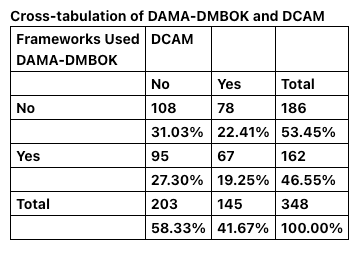
Cross-tabulation analysis reveals nuanced adoption trends: approximately 19.25% of respondents utilize both frameworks concurrently, suggesting they are not in conflict. Additionally, 27.30% exclusively use DAMA-DMBOK, while 22.41% solely implement DCAM, suggesting each framework uniquely addresses distinct organizational requirements. Meanwhile, a substantial portion of organizations (31.03%) still operate without formal frameworks, and those that do use a wide range of approaches — from DAMA and DCAM to custom-built models — reflecting the field’s diversity but also a lack of standardization.
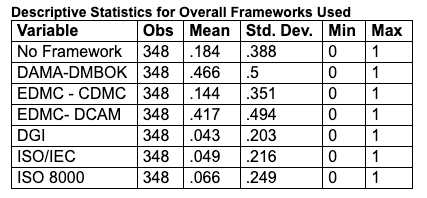
Examining overall framework adoption reveals that DAMA-DMBOK is the most commonly cited (46.6%), closely followed by DCAM (41.7%). Usage of frameworks like the Cloud Data Management Capabilities (CDMC) and various ISO standards remains notably lower, at approximately 14.4% and under 7%, respectively. Remarkably, 18.4% of surveyed organizations operate without any formal data governance framework, underscoring significant variability in governance maturity across industries.
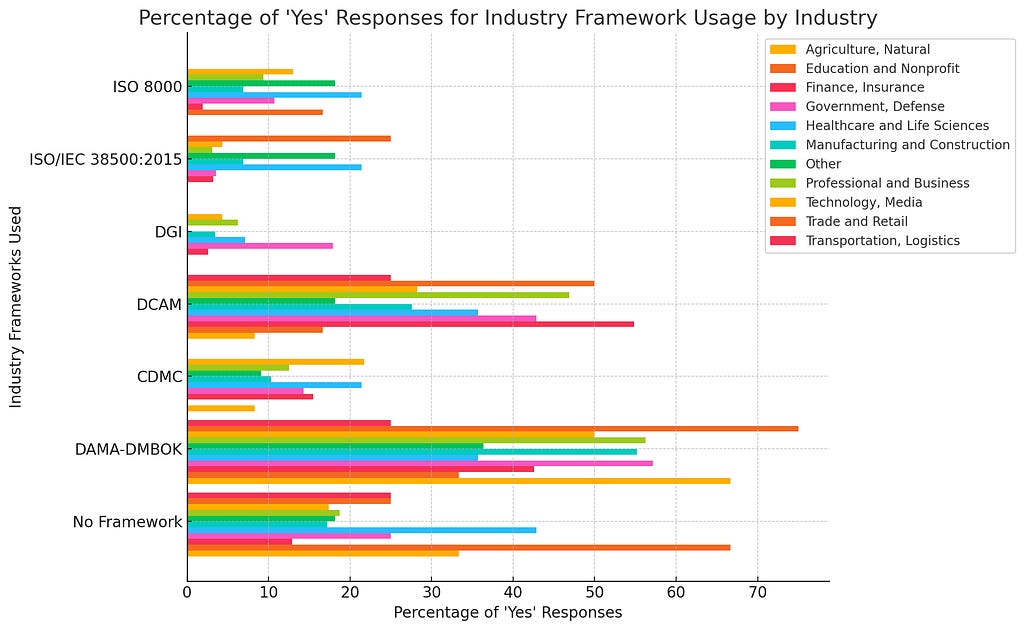
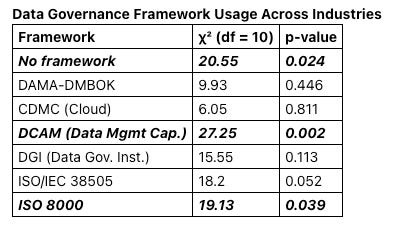
Statistical analysis further underscores significant industry-based differences in framework adoption.
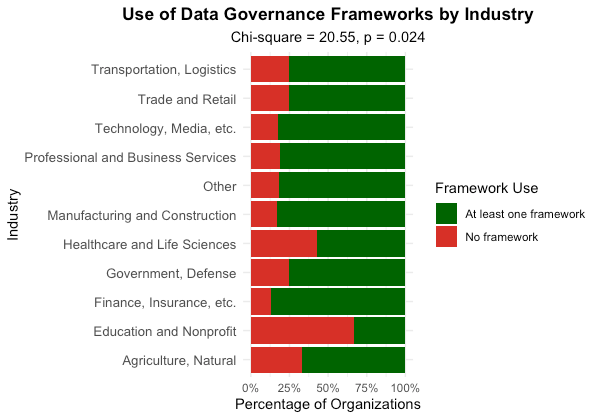
Chi-square tests confirm disparities, particularly in organizations with no formal framework and those using DCAM, with notable differences driven by factors such as regulatory requirements, organizational scale, and data intensity. Sectors like finance and technology, characterized by stringent regulation and substantial data reliance, typically exhibit higher adoption rates and advanced governance practices. Conversely, smaller or less data-intensive industries often rely on customized or informal governance practices.
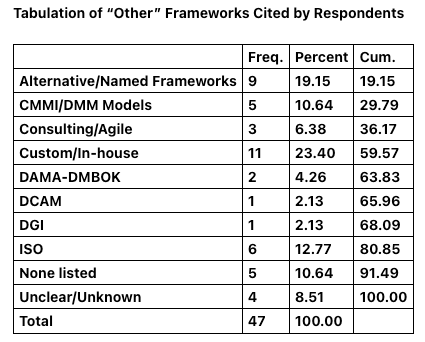
Additional examination of alternative governance frameworks reveals considerable diversity. Custom or in-house solutions were the most frequently cited alternatives (23.4%), suggesting a preference for highly tailored approaches addressing unique organizational challenges. Other noted alternatives include consulting-led, agile, or named frameworks, indicating continuous innovation and adaptation within the data governance community.
Understanding what industry frameworks practitioners and organizations apply to their data management practices is foundational to understanding predominant industry methods. These insights are crucial for evaluating the factors that contribute to the effectiveness of data governance in meeting organizational objectives, fostering necessary cultural and behavioral change, and refining strategies to manage data and information as a organizational assets.
Future analysis within my research will continue to explore these themes in greater depth, seeking to identify the attributes contributing to resilience in data governance practices. The aim is to help organizations and researchers gain a deeper, empirically informed understanding of effective data governance practices, thus enhancing the profession’s credibility and the efficacy of data governance initiatives.
Understanding Data Governance Framework Adoption Across Industries (Preliminary Findings) was originally published in My Column Has NULLs on Medium, where people are continuing the conversation by highlighting and responding to this story.